Category Error: What Happens When an Algorithm Meets Art It Was Never Built to See

Photo: Brocken Inaglory, CC BY-SA 3.0, via Wikimedia Commons
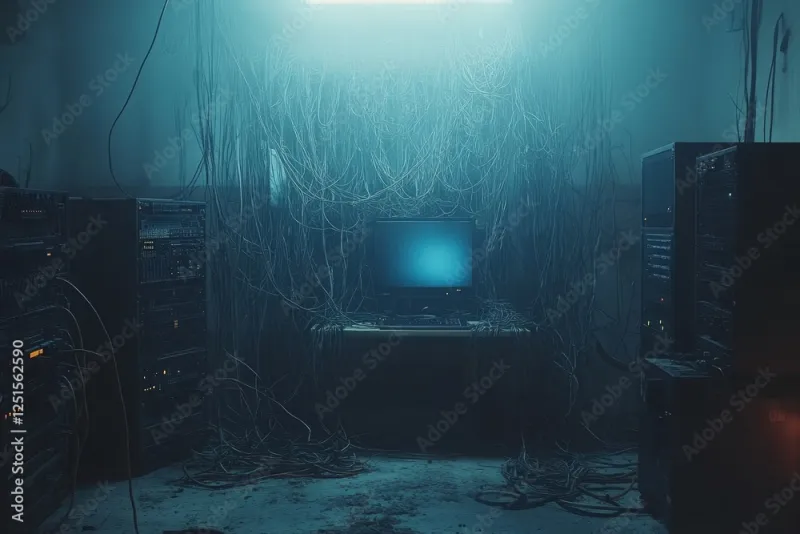
There's a video on YouTube — or there was, last time anyone checked — that the platform's algorithm apparently cannot decide what to do with. It's a forty-minute experimental film: no dialogue, no conventional narrative, composed entirely of degraded VHS footage layered over field recordings from decommissioned industrial sites. By every conventional metric, it should have zero reach. It was uploaded with no tags, no SEO-optimized description, no promotional push.
Instead, it surfaces periodically in the recommendation feeds of people who have nothing obvious in common. Horror fans. Ambient music listeners. People who just finished watching a documentary about urban decay. A teenager in Ohio who'd been watching skateboarding videos for three hours.
Nobody can quite explain why. Including, apparently, the algorithm.
The Map and the Territory
Recommendation systems are, at their core, cartography projects. They build maps of content — clusters of videos, songs, articles, images organized by similarity, engagement patterns, metadata, and a thousand other signals — and then navigate users through those maps toward content they're likely to engage with.
The system works remarkably well when the territory is legible. A true crime podcast fits into a well-mapped cluster. A pop song has known neighbors. The algorithm knows where these things live and how to route people toward them.
But what happens when a piece of content doesn't fit the map? When it actively resists categorization — not by accident, but as a formal choice? When the creator's intent was specifically to produce something that occupies no established genre, triggers no clean association, and refuses to sit still long enough to be labeled?
This is where things get interesting. And strange.
Behavioral Anomalies at the Edge
Researchers and platform observers have documented a cluster of behaviors that tend to emerge when recommendation systems encounter genuinely anomalous content. The patterns are consistent enough across platforms that they suggest something structural rather than incidental.
The first is what some have called the promiscuous recommendation — content that gets surfaced across wildly incompatible audience segments because the algorithm, unable to identify its proper neighborhood, essentially tries everywhere. The experimental film reaching horror fans and skateboarders simultaneously is a clean example. The system is doing something like a shrug in machine language.
The second is recommendation loop collapse. Normally, a platform's recommendation engine creates a kind of gravity — once you're in a content cluster, it tends to pull you deeper. Anomalous content can break this. Users report that encountering certain experimental or transgressive works causes their recommendation feeds to reset or fragment in ways that feel almost disorienting. The map tears. The platform doesn't know where to send you next.
The third — and arguably the most interesting — is what happens over time. Because recommendation systems learn from engagement, content that generates unusual engagement patterns (long watch times on short videos, or vice versa; high share rates with low like counts; comments that span wildly different demographics) can cause a kind of local mutation in the algorithm's behavior. The system updates itself around the anomaly, and the updates propagate outward in ways nobody planned.
Accidental Communities
Here's the part that nobody designing these systems intended: the glitches create scenes.
When an algorithm doesn't know where to route something, it routes it everywhere. And when it routes it everywhere, some of the people who encounter it are exactly the right people — the ones for whom this weird, unclassifiable thing is precisely what they didn't know they were looking for. Those people find each other in the comments. They share the content. They build communities around it.
This dynamic has produced some genuinely unexpected cultural formations. Microgenres that don't have names. Niche communities organized around aesthetic sensibilities that never had a label before the algorithm started bundling them together by accident. Artists who found their audiences not because of any promotional strategy but because a platform's recommendation engine had a small, productive breakdown.
"The algorithm failing is sometimes the most honest thing it does," says one digital artist who has spent years making work specifically designed to resist easy categorization. "When it doesn't know what to do with you, it tells you something true about where the edges of the system are."
Those edges are revealing. The categories a platform uses to organize content are also, necessarily, a theory of what kinds of culture exist and matter. When something doesn't fit, the misfit is informative — it shows you the shape of the container by showing you what won't go inside it.
The Transgressive as Technical Stress Test
Some artists and researchers have started treating algorithmic confusion as a medium in itself. If you understand how a recommendation system categorizes content, you can build things that are specifically designed to break that categorization — not to evade detection, but to probe the system's assumptions.
This is weirder than it sounds. It means thinking about creative choices — pacing, genre signals, metadata, engagement bait and its deliberate absence — as inputs into a machine whose behavior you're trying to influence. The art object becomes a kind of diagnostic tool. What does the algorithm do when you remove every signal it's trained to recognize? What does it do when you give it contradictory signals simultaneously?
The answers are sometimes funny, sometimes genuinely illuminating, and occasionally unsettling. Platforms have enormous power over cultural visibility, and the logic governing that power is largely opaque. Experimental work that forces the algorithm into visible confusion is, in a small way, making that logic legible.
What the Glitch Reveals
There's a broader point here that goes beyond the niche world of experimental digital art. Every major platform is, at its core, a classification system. It decides what counts as similar to what, which audiences belong together, what content deserves amplification and what gets buried. Those decisions shape what gets made, what gets seen, and — over time — what kinds of culture feel possible.
When the classification system encounters something it can't classify, the resulting behavior is a kind of involuntary transparency. The algorithm shows you its seams. You can see, for a moment, the assumptions baked into its architecture — the genres it believes in, the audiences it expects to exist, the kinds of engagement it was built to reward.
The forty-minute VHS collage reaching a teenager in Ohio is, from one angle, just a weird algorithmic accident. From another angle, it's the platform accidentally admitting that its map of culture has holes in it.
Something is living in those holes. The signal breaks, and that's exactly when you find out what was always there, just outside the frame.