Ouroboros.exe: The Moment TikTok's Algorithm Started Recommending Itself
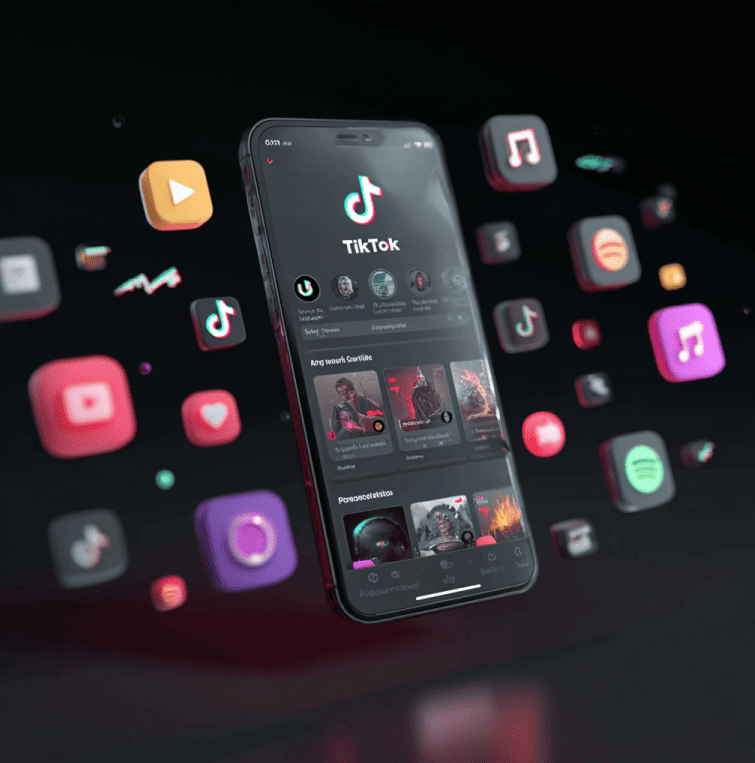
Photo: smartphone screen TikTok app glowing neon abstract algorithm visualization, via www.headcountcoffee.com
There's a specific flavor of weird that only exists on TikTok at 2 a.m. You weren't looking for it. You don't fully understand it. And yet the app is absolutely certain you need to see seventeen more videos exactly like it. The content isn't quite human. It isn't quite machine. It sits in this uncanny middle space where the algorithm and the creator have been in conversation so long that neither one remembers who started talking first.
That's the glitch. And it runs deeper than most people realize.
The Loop That Ate Itself
At its most basic level, TikTok's For You Page is a feedback engine. It watches what you watch, notes what makes you scroll away, and recalibrates in real time. That part is well-documented. What gets less attention is what happens when that feedback loop stops being about you at all.
Creators learned early that certain content patterns — specific pacing, particular audio cues, a certain style of visual hook in the first three seconds — reliably triggered the algorithm to push their videos further. So they optimized. They watched what worked, replicated the structure, and posted again. The algorithm rewarded them. They optimized harder.
At some point in that cycle, the content stopped being made for human viewers and started being made for the recommendation system itself. The human audience became almost incidental — a necessary biological component in a feedback loop that had developed its own internal logic.
Genres That Shouldn't Exist (But Do)
The evidence is everywhere once you know what you're looking for. Take the "oddly satisfying" pipeline, which by 2022 had evolved so many sub-layers that it spawned entire accounts dedicated to nothing but watching other people react to satisfying videos — a genre created entirely because the algorithm needed a new tier of content to sit between the original satisfying videos and the commentary videos about them.
Or consider the "POV" format, which started as a creative device and gradually mutated into something almost ritualistic — videos where the scenario described in the text overlay has no relationship to the footage being shown, because the text hook and the visual hook had each been separately optimized to trigger engagement, then stitched together without anyone asking whether they belonged in the same video.
Then there's what some creators have started calling "algorithm bait" content: videos that are deliberately constructed to be ambiguous, slightly unresolved, or just confusing enough that viewers rewatch them. Not because the creator had something confusing to say, but because replays are a positive signal to the recommendation engine. The confusion is the product. The algorithm asked for it, in its way.
The Micro-Culture Problem
Here's where it gets genuinely strange. These algorithmically-generated formats don't just exist in isolation — they develop communities. Real people start identifying with them. Inside jokes emerge. There are TikTok users who would describe themselves as part of the "NPC streaming" community or the "core" aesthetic pipeline, neither of which existed as a concept before an algorithm decided to cluster certain engagement patterns together and push them at receptive audiences.
The platform didn't intend to create subcultures. It was trying to maximize watch time. But the side effect of pushing highly-specific content clusters at users who engage with them is that those users find each other, recognize shared taste, and start building identity around it. The algorithm accidentally engineers communities out of recommendation patterns.
Some of these micro-cultures are harmless and kind of delightful. Others are more troubling — there's documented evidence that radicalization pipelines on various platforms operate on exactly this mechanic, where an algorithm chasing engagement gradually walks a user through increasingly extreme content not because anyone designed that path, but because each step in the chain was the highest-engagement option available at that moment.
When the Signal Becomes the Source
What makes TikTok's version of this particularly interesting is the speed. The platform's algorithm is widely considered the most aggressive content-to-user matching system ever deployed at consumer scale. That aggressiveness means the feedback loops run faster and the self-referential weirdness compounds quicker than it did on YouTube or Facebook.
Researchers at MIT and various independent labs have noted that TikTok's recommendation system appears to weight completion rate so heavily that it has effectively incentivized a specific video length (roughly 7-15 seconds for maximum loop potential) that has nothing to do with how long it takes to communicate any particular idea. The format ate the content. The container started dictating what goes inside it.
Creators who've tried to make longer, more substantive videos frequently report the algorithm essentially ignoring them unless they artificially break the content into pieces — optimizing the structure for the recommendation engine even when the subject matter doesn't call for it.
The Platform as Funhouse Mirror
What you end up with is a platform that increasingly reflects its own recommendation logic back at itself. New users arrive and get fed content that was shaped by the algorithm. They create content in response, which gets filtered through the algorithm. That content shapes the next generation of creators' understanding of what TikTok is, which shapes what they make, which feeds the algorithm again.
The human intent that was supposedly the whole point — people making things for other people — gets progressively diluted with each pass through the loop. The platform doesn't show you what people want to make. It shows you a heavily processed version of what the algorithm decided people should want to make, based on what it previously decided people wanted to see, based on what it had already decided to show them.
It's a mirror reflecting a mirror reflecting a mirror, and somewhere in the infinite recursion, the original image got lost.
That's the ouroboros moment. The algorithm eating its own tail. And the wildest part? It's still running. Right now, somewhere in a data center, TikTok's recommendation system is generating the micro-genre that will define 2026, and nobody — not the engineers, not the creators, definitely not you — has any idea what it's going to be.